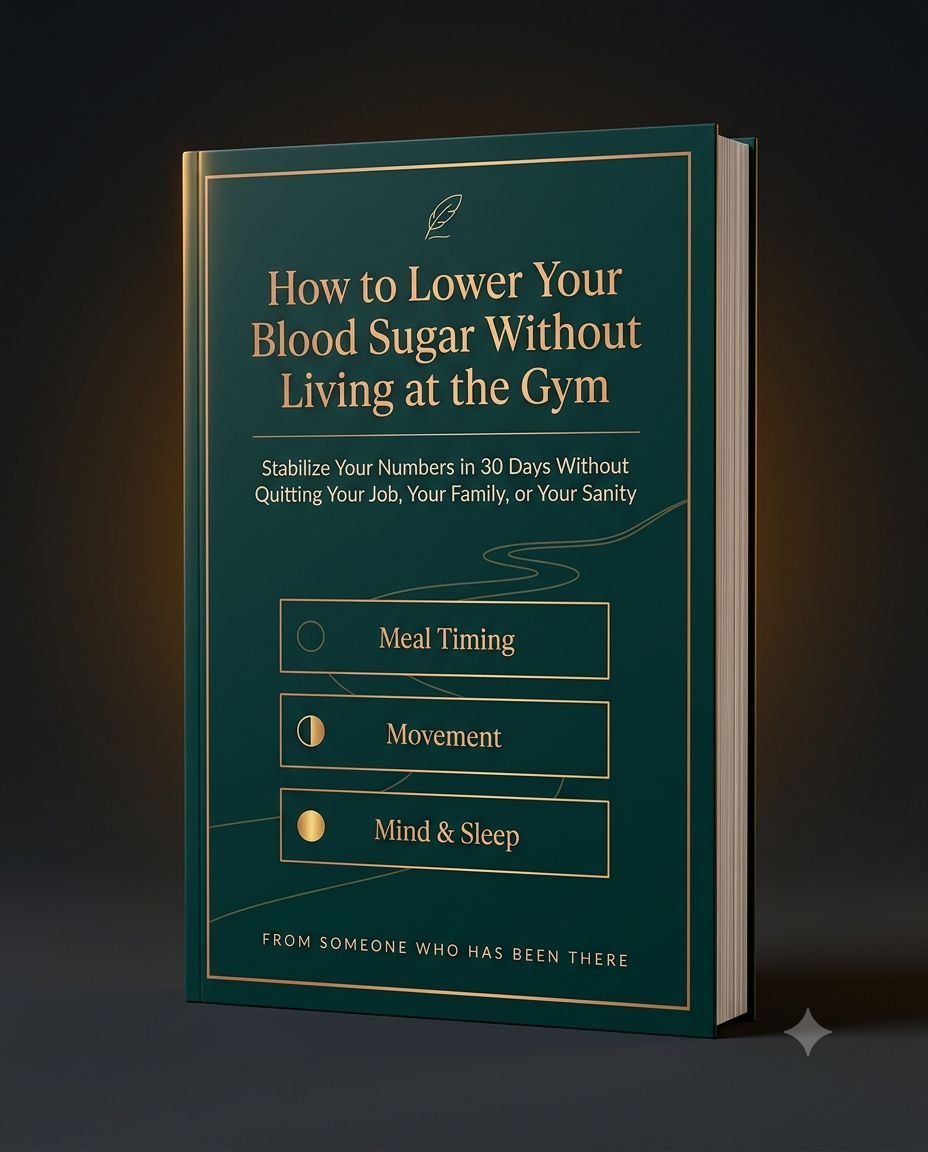
How to Lower Your Blood Sugar Without Living at the Gym
Stabilize your numbers in 30 days without quitting your job, your family, or your sanity
You saw the number. And something in you went quiet.
Maybe it was a routine test. Maybe it was a workplace health check you almost skipped. Maybe it was a machine in a pharmacy you stepped up to on a whim. Whatever it was, the number came back higher than it should be, and now it's sitting in the back of your mind like a low hum that won't switch off.
You told yourself you'd fix it. You went hard — cut the rice, cut the swallow, joined a gym, maybe even paid for three months upfront to force yourself to go. For a week or two, it worked. You felt proud. Disciplined. In control for the first time in a while.

Then work happened. Or the kids needed you. Or exams came. Or you just got tired — the kind of tired that has nothing to do with willpower and everything to do with real life not pausing for your health plan.
The gym visits got shorter, then further apart, then stopped. The rice came back, quietly, the way things do when nobody's watching. And somewhere underneath it all, a thought settled in that you haven't said out loud to anyone: maybe I just don't have what it takes to fix this.
You do. You just never had a plan built for your actual life.
Here's what nobody told you
Here's the part almost nobody explains to you when you get that scary reading: the extreme plan was never going to work long-term — not because you're weak, but because of how your body actually responds to extremes.
When you go from a normal routine to two-hour gym sessions and near-zero carbs overnight, your body doesn't just calmly adjust. It treats the sudden restriction and intensity as stress — and stress raises cortisol. Cortisol tells your liver to release stored sugar into your bloodstream, because your body thinks you're in danger and needs fast energy. So some people going extreme actually see their sugar behave unpredictably in the first few weeks, which is confusing and disheartening precisely when they need to see progress.
Meanwhile, there's a much quieter action that does something extreme workouts don't: a short walk after a meal. When your muscles are active, they pull glucose out of your bloodstream directly to use as fuel — through a pathway that doesn't rely heavily on insulin, which matters if your body has become less sensitive to insulin's signal. Just 10–15 minutes of walking after eating can measurably blunt a blood sugar spike. Not a theory — basic exercise physiology.

The other half nobody tells you: when you eat matters almost as much as what you eat. Spacing carbohydrates instead of front-loading them, and pairing them with protein or fibre instead of eating them alone, changes how fast sugar enters your bloodstream in the first place.
None of this requires two-hour gym sessions or giving up rice forever. It requires consistency in the right small places — which is exactly what a busy, tired adult can actually sustain.
My story, in full
I want to tell you exactly what happened, because I think you'll recognise most of it.
I didn't get a diagnosis. That's actually part of what made it worse. There was no doctor sitting me down with a clear label and a clear next step — just a number that was high enough to frighten me, and a nurse who moved on to the next patient before I could ask the three questions spinning in my head. I left that appointment with more fear than information.
I did what I suspect you did. I panicked quietly, told almost nobody, and went straight into the hardest version of "fixing myself" I could think of. Gym four times a week. Running most mornings. I was chasing 15,000 steps a day like it was a punishment I owed my own body. I cut carbs down to almost nothing — no swallow, barely any rice, nothing "processed." I remember standing in my kitchen one evening eating boiled vegetables and feeling proud and miserable at the same time, thinking, this is what discipline is supposed to feel like, right?
For the first two weeks, it genuinely felt like it was working. I had that adrenaline of "I'm finally taking this seriously." I was checking my sugar constantly, treating every good reading like proof I was winning and every bad one like proof I was failing.
Then life did what life does. My schedule at the time — teaching, marking, preparing practical sessions for a full class of students — didn't leave room for the version of "health" I'd built for myself. I remember sitting in my car outside the gym one evening, engine off, just staring at the entrance, feeling this heavy mixture of guilt and exhaustion, and deciding not to go in. That was the moment the whole plan quietly started to unravel.
Within a month, the rice was back. The runs were gone. And the number — the same number that had frightened me into all of this — started creeping back up. I remember checking it one night and just sitting with this specific, quiet shame. Not the shame of the number itself, but the shame of I tried, and I still couldn't keep it up. I didn't tell my family. I didn't tell my close friends. I definitely didn't go back to a doctor, because some part of me didn't want to be told, again, that I'd failed at something that was supposed to be simple.
Here's what actually shifted things — and it wasn't dramatic. At the time, I was teaching anatomy and physiology to student nurses, walking them through how the cardiovascular and metabolic systems actually respond to stress, movement, and food. I was explaining insulin sensitivity and glucose uptake to a room full of twenty-year-olds, and somewhere in the middle of one of those lectures, I stopped and thought: I am teaching this. Why am I not using it on myself?
I went home that evening and rebuilt everything from scratch — not bigger, smaller. I stopped trying to out-exercise the problem and started working with how the body actually processes sugar. A 15-minute walk after my main meal, not a punishing run before it. Carbs spaced across the day instead of avoided entirely, and never eaten alone — always with some protein or fibre alongside. I started protecting my sleep, because I'd learned, and then re-learned through my own numbers, how much stress and poor sleep quietly raise blood sugar on their own.
Within days, something felt different — not dramatic, but real. Less of the heavy, foggy feeling after meals. Fewer of those sudden energy crashes in the early afternoon that used to send me looking for something sweet. Over the following weeks, my numbers started moving in the right direction — steadily, not perfectly, but steadily — and for the first time, the plan didn't feel like something I was gritting my teeth to survive. It felt like something I could actually keep doing on a normal, busy, imperfect week.
That's the guide sitting in front of you. Not the version built for someone with three free hours a day. The version built for someone with a job, a family, deadlines, and a life that doesn't pause — because that's who actually built it, for exactly that reason.
What the 30 days looks like
You start the meal-timing structure and the first 15-minute post-meal walks. Nothing dramatic yet — this is about building the habit before you look for the win.
Most people notice the afternoon energy crash softening — that heavy, sleepy feeling after lunch starts to lift.
The habit starts to feel automatic rather than effortful. This is usually where the old extreme-plan approach would have already collapsed under a busy week — this one is built to survive it.
Typically when people start re-checking their numbers and seeing early movement in the right direction.
The routine has usually absorbed at least one "chaotic" week and survived it — the actual test the extreme plan never passed.
You complete the full protocol with a system you can keep going, not one you're relieved to be finished with.
Individual results vary based on starting point, consistency, and other health factors — this is a lifestyle protocol, not a medical treatment, and it works alongside your doctor's guidance, not instead of it.
Inside the guide
- Why the Extreme Plan Failed You (And It Wasn't Your Fault)pp. 3–9
- The 15-Minute Reset Methodpp. 10–22
- The Carb Reference Sheetpp. 23–28
- The Day-by-Day Walkthroughpp. 29–41
- The "Bad Week" Planpp. 42–45
- Talking to Your Doctorpp. 46–48
Your bonus tools — first 50 buyers only
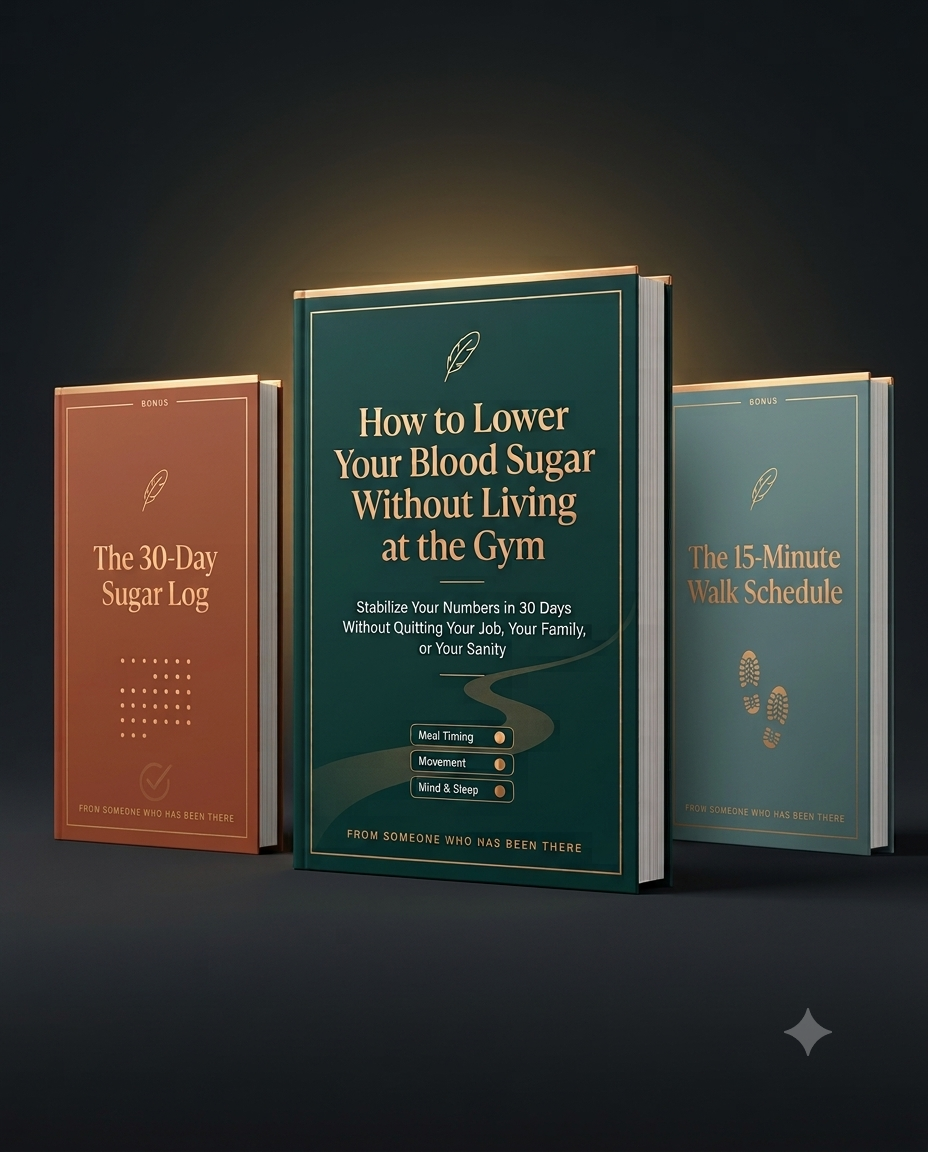
The 30-Day Sugar Log
A simple, printable daily tracker built specifically for this protocol — not a generic diabetes log with fifteen confusing columns. Track what actually matters: meal timing, your walk, and how you felt.
The 15-Minute Walk Schedule
A structured, no-thinking-required walking plan for all 30 days, including what to do on days you can only manage 5 minutes instead of 15.
Your offer today
Try it for 30 days. If it's not for you, get your money back.
Go through the guide. Follow the protocol. If after 30 days you don't feel it was worth what you paid, email us and we'll refund you in full — no interrogation, no guilt trip.
What happens next
P.S. — This comes with a full 30-day money-back guarantee. There's no risk in trying this properly.
P.P.S. — The two bonus tools are only guaranteed for the first 50 buyers. Once that's gone, they're gone.
P.P.P.S. — You already know what happens if you close this page and go back to figuring it out alone. You've done that. This is the other option.
This guide is for educational purposes and is designed to work alongside your doctor's care, not replace it. Always consult a healthcare professional, especially if you are on medication. Secure checkout. Instant digital download.